Posts Tagged 'Hebrew History'


HEBREWS: THE DOCTRINE OF FAITH, PART 4

Hebrews 11:24—31

Faith Begins in Egypt

The back story of Moses’ life proves what we all know: the early years of a child’s life are sometimes more important than the later years in a child’s life. Moses’ mother had him while he was most mailable. We may be certain that as a devout Jewess, she schooled him in the knowledge of his religion and in the ways of the one true God. No doubt as Moses grew into a young man, he couldn’t help but compare the simple God-fearing ways of his mother’s people to the exciting, glittering yet empty life of the Egyptian court.

Moses, as an adult is an excellent example of the of faith. As the son of Pharaoh’s daughter, he had been treated like an Egyptian prince. Even while his people were suffering, he was enjoying the good life of going to school in Egypt. Scholars believe that had Moses kept to his Egyptian life, and remained faithful to his Egyptian family, he would have ascended to the throne of Egypt.

But as a man of faith, Moses knew deep inside that God—the God of the Israelites—had other plans.

1. The choice of faith, 11:24—26

By faith Moses, when he had grown up, refused to be known as the son of Pharaoh’s daughter. He chose to be mistreated along with the people of God rather than to enjoy the pleasures of sin for a short time. (vs. 24, 25)

Acts 7 gives us some important details:

When he was placed outside, Pharaoh’s daughter took him and brought him up as her own son. Moses was educated in all the wisdom of the Egyptians and was powerful in speech and action. (Acts 7:21, 22)

Stephen obviously knew some Hebrew history because he goes on to say that Moses was 40 years old when when he decided to side with the Israelites. To the observer looking at Moses’ decision to disavow his Egyptian family and to forsake the throne, the young prince must have looked like a fool. But Moses’ faith, not seen for 40 years, came to the surface in the form of a forthright choice. In full knowledge of what he was about to do, Moses made a courageous decision in faith. Here is an important component of true Biblical faith: The outward decision to turn his back on his Egyptian life was the result of a previously made inward decision. Part of Biblical faith is the ability to make up ones mind and to come down on the right side of a choice. Biblical faith is not blind. Biblical faith does not insist that you deny reality, cling to unrealistic dreams, or turn a blind eye to the immediate consequences of your faith-inspired decision. Biblical faith is the ability to make, what often is a difficult and painful choice because it is the right choice.

He regarded disgrace for the sake of Christ as of greater value than the treasures of Egypt, because he was looking ahead to his reward. (vs. 27)

The pleasures of Egypt would last only a short time, but with no future. Associating with God’s people might bring hardship on Moses, but there would be a future, and this Moses somehow was able to sense. He considered the rewards of faithfully serving God far greater than the momentary and temporary satisfactions which come from position and fame.

Verse 27 is interesting because the writer is very emphatic in writing that Moses made his choice for the sake of THE Christ. Obviously, Moses had no knowledge the Person and work of Christ as we know Jesus from the pages of the New Testament. Elsewhere in this letter to the wavering Hebrews, we read this:

Jesus Christ is the same yesterday and today and forever. (Hebrews 13:8)

Our Lord transcends the centuries. Moses the deliverer was able to see in faith the coming of the ultimate Deliverer and he was willing to surrender the glories of earth for the future glories of God’s kingdom. This is the essence of faith! All the heroes of faith had the uncanny ability to recognize their current state, but make the difficult choice to persevere because “better days lay ahead.”

By faith, then, Moses was able to see his choices clearly in light of eternity. It may have looked to some that the choice was between pleasure and prosperity with that of pain and bondage, but the truth is Moses’ choice was between godliness and sin. It was between serving the one true God or serving himself. It was a choice ultimately between heaven and hell; between immortality and oblivion. And that is the choice set before man today.

2. The endurance of faith, 11:27

By faith he left Egypt, not fearing the king’s anger; he persevered because he saw him who is invisible.

Moses actually left Egypt twice, so which leaving is the writer referring to? The first time Moses fled he did so in fear of his life after he killed an Egyptian. The second time Moses left Egypt was 40 years after that, in the mass exodus of Hebrews from the land of bondage. Given the context, the letter to the Hebrews must be referring to the Exodus. It was by faith that Moses finally and forever turned his back on Egypt after the 10 plagues. Pharaoh refused to bend to God’s will. Compared to Egypt, Israel was a weak nation getting weaker, and yet Moses led that tired nation out of the land of bondage. This made the king angry! Imagine how he must have felt…being backed into the corner by an 80 year old sheepherder, bent on leading a nation of slaves on an exodus to freedom.

Talk about an impossible task, yet by faith Moses was able to do just that because he was with God. The writer makes a valuable point here: Moses was able to persevere, not because he was so committed to the exodus or so loyal to his people, it was because “he saw him who was invisible.” Moses was God’s friend. Moses had a close relationship with God:

The LORD would speak to Moses face to face, as a man speaks with his friend. (Exodus 33:11)

Biblical faith is exemplified by one like Moses; one who has that kind of relationship with God. That close walk with the One who is invisible is what gave Moses his faith; it’s what sustained him through all those difficult days.

3. The exodus of faith, 11:28—31

Genuine Biblical must always leave Egypt. It can never stay among those who don’t possess it. This is Biblical principle for all people of faith, and it’s even expressed in the New Testament:

Therefore come out from them and be separate, says the Lord. Touch no unclean thing, and I will receive you. (2 Corinthians 6:17)

People of faith cannot survive in Egypt; they must eventually leave. Christians are called to “in the world but not of the world.”

The Passover, 11:28
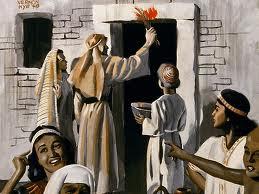
Credit: Vernon Nye, 1948

By faith he kept the Passover and the sprinkling of blood, so that the destroyer of the firstborn would not touch the firstborn of Israel.

The very first step in leaving Egypt was celebrating the Passover. The word “kept” might be better rendered “instituted.” Moses not only started the observance, but he provided for its continuing observance:

This is a day you are to commemorate; for the generations to come you shall celebrate it as a festival to the LORD—a lasting ordinance. (Exodus 12:14)

What is the significance of the Passover? The Israelites were told to do something that they had never done before that probably made no sense: sprinkle blood on their door posts and stay inside as the angel of death passed by. Who had ever heard of such a thing before? But Moses and his people in simple obedience did just what they were told to do in faith. Their faith was vindicated almost immediately when not a single first-born Israelite died that night while all the first-born of Egypt did. But notice: the people had to be obedient and follow God’s instructions. There could have been no escape from Egypt or from the darkness of death without the sprinkling of blood. However, it wasn’t the shedding of blood that saved the people, it was the application of the blood. Shed blood would have protected nobody. The Israelites were saved only because they sprinkled (applied) the shed blood individually on individual door posts of individual homes. The same thing applies to the shed blood of our Savior; the Lamb of god. It is only effective when by faith it is appropriated by the individual sinner through the work of the Holy Spirit.

Eventually, if the people of God can hang tough and hang on long enough, our faith will be vindicated, too.

Faith demands that sometimes we do things not because they make the most sense, but out of a conviction that God has told us to do them.

The Red Sea, 11:29

By faith the people passed through the Red Sea as on dry land; but when the Egyptians tried to do so, they were drowned.

For those of us who know the story, this verse makes us think. The fact is, the people of Israel had NO faith! When they saw the Pharaoh and the mighty Egyptian military closing in on them, they were angry with Moses and wanted give up and go back to Egypt. It was, in fact, Moses who had the faith. He was the one who walked down to the water’s edge and his was the staff that was plunged into the water.

Here is another aspect of genuine Biblical faith we have seen before: it can save others! The faithless people followed the example of Moses’ faith and they were commended.

We also learn a secondary lesson of the difference between faith and presumption, which does not lie in what is done but rather on whose authority. Israel acted on a divine command: YOU cross over on dry land, God had told them. But the Egyptians who were following Israel, when they tried to do the exact same thing, were drowned. What’s the difference? Both parties did the same thing, but only one did it under God’s command and in His presence. What a powerful lesson for the modern believer! This is why Christians are called to have a personal relationship with Christ. God always deals with the individual.

The walls of Jericho, 11:30
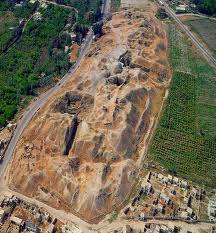
A portion of the excavated fallen walls of Jericho.

By faith the walls of Jericho fell, after the people had marched around them for seven days.

Forty years passes by, and our letter-writer settles on a truly remarkable event in Hebrew history. The story of Jericho’s fall is well-known and the crumbling of those city walls had to be the result of faith; there is no other way to explain it. Now, the author does not indicate whose faith is responsible for this event, although we can deduce it was Joshua’s faith and example and the obedience of all those who did what they were told.

Think about how strange this event must have seen to those living in Jericho. What kind of warriors were these Hebrews? They didn’t have an army. They didn’t have many weapons. They didn’t march on the city, they just marched around the city in formation.

But how can faith bring down walls, anyway? Was it positive thinking? Was it the vibrations of all those feet? Sometimes there is a psychological, subjective side of faith that produces results. But genuine Biblical faith does not rely on thought waves or physical power. Biblical faith achieves its objective mediately, not immediately, by way of two things working hand in glove: human obedience and the power of God. Therefore, when the people obeyed Joshua, who was obeying God, the walls came down. As James 2:26 says:

Faith without works is dead.

However, it must be stressed that the “works” must be ones ordered by God, not by man.

Rahab, convert, 11:31
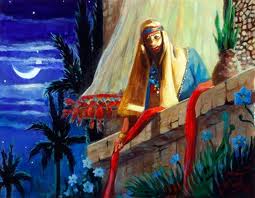
Rahab and the Scarlet Cord

By faith the prostitute Rahab, because she welcomed the spies, was not killed with those who were disobedient.

Faith knows no barriers! Rahab had nothing going for her: she was a pagan, she was a prostitute, and she was a woman. In Rahab we see faith in the unlikliest of places! She knew nothing about God, but she was familiar with Israel’s recent history. She, like her people, feared the God of Israel because of what happened to the Egyptians. But somehow, through her fear, she could see God’s plan for His people and she seemed to believe Israel’s God. She received no assurance of salvation, no gospel of faith and repentance and no assurance of acceptance. What moved her to express faith? She had heard all about what God had done for His people and her faith was based solely on the works of God.

When we heard of it, our hearts melted and everyone’s courage failed because of you, for the LORD your God is God in heaven above and on the earth below. (Joshua 2:11)

There was never a more simple and basic confession of faith! But it was from her heart and she acted in faith. She welcomed the spies and hid them at great personal risk. But she trusted God that when Jericho fell, she and her family would be spared.

…unless, when we enter the land, you have tied this scarlet cord in the window through which you let us down, and unless you have brought your father and mother, your brothers and all your family into your house. (Joshua 2:18)

But Joshua spared Rahab the prostitute, with her family and all who belonged to her, because she hid the men Joshua had sent as spies to Jericho—and she lives among the Israelites to this day. (Joshua 6:25)

Rahab did exactly what she was told. In that scarlet cord given to Rahab we see a type of the longer “scarlet cord” of redemption which runs from Genesis to Revelation; the “scarlet cord” which binds believer’s to their Savior.

James cites Rahab’s faith as an example of one being justified by works:

In the same way, was not even Rahab the prostitute considered righteous for what she did when she gave lodging to the spies and sent them off in a different direction? (James 2:25)

Biblical faith is able to combine the divine and the human to achieve God’s will.  In other words, there is an indispensable component to Biblical faith:  ours.

SAUL: His Decline

Samuel and Saul

1 Samuel 13:1—15

The history of Saul’s reign as Israel’s first king really begins in chapter 13, and according to the custom of recording the history of the kings, it begins with a statement of his age.  The NIV begins like this—

Saul was thirty years old when he became king, and he reigned over Israel forty-two years.  (1 Samuel 13:1)

A look at how the RSV translates this verse shows the difficulty translators had in tackling this verse—

Saul was…years old when he began to reign; and he reigned…two years over Israel.

And the literal version sounds like this—

A son of a year [is] Saul in his reigning, yea, two years he hath reigned over Israel.

What does all this mean?  The NIV has calculated that Saul was 30 years old when he became king, but the text does not say that.  In fact, Saul could have been 40 years old.  What we know for sure is that his son, Jonathan, was fully grown by now and an accomplished warrior.   So why is the Hebrew so obscure?  Given the disaster that Saul would become, some Bible scholars offer this paraphrase of the obscure Hebrew—

Saul was like a child of one year when he began to regin…

Saul was chosen out of obscurity and rose to dizzying heights in such a brief time that he was unprepared for the office and as clueless as the people he was leading.  According to God, the only preparation Saul needed was to be obedient to Him.  But no, he could not do that.  Saul was a product of a corrupt generation and the people got a leader exactly like they were.

While the story of Saul’s reign begins here, so does the story of his decline.  It is not a stretch to say that after an initial victory at Jabesh Gilead, Saul was a complete failure as a political leader.  But the prophet Samuel, in love and faithfulness to the Lord, told the nation of Israel in his farewell address in response to this request—

The people all said to Samuel, “Pray to the LORD your God for your servants so that we will not die, for we have added to all our other sins the evil of asking for a king.”

“Do not be afraid,” Samuel replied. “You have done all this evil; yet do not turn away from the LORD, but serve the LORD with all your heart.  Do not turn away after useless idols. They can do you no good, nor can they rescue you, because they are useless.  For the sake of his great name the LORD will not reject his people, because the LORD was pleased to make you his own.  As for me, far be it from me that I should sin against the LORD by failing to pray for you. And I will teach you the way that is good and right.  But be sure to fear the LORD and serve him faithfully with all your heart; consider what great things he has done for you.  Yet if you persist in doing evil, both you and your king will be swept away.” (1 Samuel 12:19—25)

Saul was given every opportunity to succeed in his new career, and like another king of Israel, Uzziah, he was helped by God until he was strong—

In Jerusalem he made machines designed by skillful men for use on the towers and on the corner defenses to shoot arrows and hurl large stones. His fame spread far and wide, for he was greatly helped until he became powerful.

But after Uzziah became powerful, his pride led to his downfall. He was unfaithful to the LORD his God, and entered the temple of the LORD to burn incense on the altar of incense.  (2 Chronicles 26:15—16)

The pride that resulted in his success would surely end in Saul’s destruction.  Did God forsake Saul?  According to Samuel, Saul forsook God and reaped what the seeds of his disobedience produced.

1.  Saul’s duty was obvious, verse 8

He waited seven days, the time set by Samuel; but Samuel did not come to Gilgal, and Saul’s men began to scatter.

In order to fully understand this verse, we need to glance back at 10:8—

“Go down ahead of me to Gilgal. I will surely come down to you to sacrifice burnt offerings and fellowship offerings, but you must wait seven days until I come to you and tell you what you are to do.”

This was some time before the events of chapter 13, but this was what Saul was supposed to do when the situation warranted it.  But here is the true nature of Saul’s heart working itself out in disobedience.   This word from God given through Samuel was given, perhaps, as many as three years before, but that did not negate it; this was a standing order from God for Saul’s benefit.  Saul needed God’s help, and all he had to do get it was to obey.

Saul’s sin was not that as king he was forbidden to offer sacrifices.  Consider what Kinds David and Solomon did—

David built an altar to the LORD there and sacrificed burnt offerings and fellowship offerings. Then the LORD answered prayer in behalf of the land, and the plague on Israel was stopped.  (2 Samuel 24:25)

Then Solomon awoke—and he realized it had been a dream.  He returned to Jerusalem, stood before the ark of the Lord’s covenant and sacrificed burnt offerings and fellowship offerings.  Then he gave a feast for all his court. (1 Kings 3:15)

Saul sinned simply because he disobeyed God’s word through the prophet Samuel, and he would do it again near the end of his career.

What is our duty as Christians?  To obey the Word of God; our responsibility is to live according to the light we have in God’s revealed Word, the holy Bible.  There are those in Church today who teach that parts of the Bible are outdated and no longer apply to modern Christians.  Liberal theologians teach that these parts of the Bible, especially the Old Testament, are “lesser inspired” and modern Christians can overlook them.  But, here is what some “lesser inspired” verses say—

Preserve my life according to your love,
and I will obey the statutes of your mouth.

Your word, O LORD, is eternal;
it stands firm in the heavens.

Your faithfulness continues through all generations;
you established the earth, and it endures.  (Psalm 119:88—90)

The eternity of God’s Word is linked to His unfailing love.  If we, like Saul, are conscious of having been chosen by God and anointed by God by being filled with His Holy Spirit, then the revealed Word must become our absolute rule to live by; it needs to be the unconditional law of our lives—all of it, not just the parts we like or make us feel good.

2.  His faith was tested, verse 5

The Philistines assembled to fight Israel, with three thousand chariots, six thousand charioteers, and soldiers as numerous as the sand on the seashore. They went up and camped at Micmash, east of Beth Aven.

These ancient enemies of God’s people hated Israel; Israel literally stunk to them.  As a result, Saul mustered his troops to Gilgal.  He started out waiting for Samuel as prescribed by the prophet.  But we read this—

He waited seven days, the time set by Samuel; but Samuel did not come to Gilgal, and Saul’s men began to scatter. (verse 8)

Why did the men scatter?  Obviously they scattered because they were afraid and they were afraid because Saul was not leading them.  Beyond one single battle, what had Saul ever done to inspire the confidence of his people?  In fact, the great military brain of the family was Saul’s son Jonathan, not Saul!  Jonathan won a great victory and his father took the credit for it!  Who would trust a man like that?  He took credit for something somebody else did!  So the men took to hiding.  Poor Saul; he was unable to keep his troops together.

What we are witnessing here is a test of Saul’s faith.  Notice that Saul outwardly obeyed God.  His problem was he failed to trust God, failed to trust Samuel and instead he couldn’t take his eyes off his frightened soldiers.  In other words, Saul’s outward circumstances determined the strength of his faith instead of the other way around.

Now faith is being sure of what we hope for and certain of what we do not see.  This is what the ancients were commended for.

By faith we understand that the universe was formed at God’s command, so that what is seen was not made out of what was visible.  (Hebrews 11:1—3)

For we walk by faith, not by sight.  (2 Corinthians 5:7)

Of course his circumstances were desperate; desperate circumstances always highlight a person’s faith.  And there is always a struggle between faith and sight.  But the reality for the believer lays, not in what they can see, but in their faith in what God has said.  We assume that what we see is what is real, but that is not what the Bible teaches. But this is what Saul thought; the desperate circumstances he found himself in negated God’s word.  God Word is never negated by circumstances.

3.  His failure was complete, verses 9, 10

So he said, “Bring me the burnt offering and the fellowship offerings. ” And Saul offered up the burnt offering.  Just as he finished making the offering, Samuel arrived, and Saul went out to greet him.

Saul waited almost the whole time, but he grew impatient with Samuel.  Really, Saul grew impatient with the will of God; things were not happening fast enough for him; God wasn’t doing things the way Saul thought they should have been done, so he took matters in own hands.  He chose his own way and stepped out of God’s will and favor.

Every single Spirit-filled believer will have their faith tested.  Even our Lord, Jesus Christ, the very Son of God, was not exempt from this testing.  As soon as He was baptized and filled with the Holy Spirit, He was purposely led into the wilderness to be tested by that same Holy Spirit!   Thank God He remained faithful.

Abraham was tested, and thankfully he passed otherwise he never would have become the father of the faithful!

Yet he did not waver through unbelief regarding the promise of God, but was strengthened in his faith and gave glory to God.  (Romans 4:20)

And Moses was tested and the whole nation of Israel survived because he stood his ground and remained faithful—

By faith he forsook Egypt, not fearing the wrath of the king: for he endured, as seeing him who is invisible.  (Hebrews 11:27)

That is how you become useful to God:  by enduring as seeing him who is invisible.  If, when we face our testing, we fear and we take our eyes off of God and see our circumstances, we become life-long cripples in the work of the Lord; we become useless to Him.  Whenever, as servants of God, we choose our way rather than God’s way as revealed in His Word or when we rush ahead of God instead of waiting on Him, we become like bones out of joint in the Body of Christ.  What a painful way to live.

5.  His excuse was lame, verses 11, 12

“What have you done?” asked Samuel.

Saul replied, “When I saw that the men were scattering, and that you did not come at the set time, and that the Philistines were assembling at Micmash,  I thought, ‘Now the Philistines will come down against me at Gilgal, and I have not sought the LORD’s favor.’ So I felt compelled to offer the burnt offering.”

In a sense, we can almost understand Saul’s motivation to offer the sacrifice.  His army was deserting him, the Philistine army was pressing in, Samuel was long in coming, and Saul’s own patience was waning.  Saul’s excuse to Samuel was to point to the circumstances and point out the urgent need to seek God.  What Saul did not realize is that animal sacrifice was not what moves the Hand of God.

And Samuel said, Hath the LORD as great delight in burnt offerings and sacrifices, as in obeying the voice of the LORD? Behold, to obey is better than sacrifice, and to hearken than the fat of rams.  (1 Samuel 15:22, KJV)

There is never an excuse for disobedience.  We all want to be the exception to the God’s rule, and we make lame excuses just like Saul did:

  • My marriage was falling apart and my secretary loves me more than my wife, so I don’t think I really committed adultery.
  • Things are really tight this month, so God will understand why I don’t tithe.
  • I didn’t lie, I misspoke.
  • Who cares if our new pastor is gay.  He still loves God, and really, everybody sins, right?  He such a nice man.
  • Well, I know that what Jesus said, but nobody can live up to that!  Besides, God knows I am only human, right?

No argument and rationalization can mitigate the guilt of doing what we know to be contrary to the Word of God.   The saddest part of this story is how Saul tried to justify what he did by blaming everybody but himself.

What’s worse is that even after Samuel’s rebuke and solemn warning; Saul showed absolutely no signs of sorrow or repentance.  He proceeded to number his followers.  When we have sinned and when we find out we have made a mistake, when we stumble and fall and fail, and when we disobey, repentance and confession is the only way to get back into God’s favor and make things right.

6.  The consequences terrible, verse 14

But now your kingdom will not endure; the LORD has sought out a man after his own heart and appointed him leader of his people, because you have not kept the LORD’s command.”

Saul turned away from God, and so God chose another man to take his place.  Saul was a man after his people’s heart, but God’s new man would be a man after God’s own heart.  We might look at this and think God was reacting harshly to what Saul did.  But Saul was warned not once but twice that if he did not obey God’s command, he would be replaced by someone else.  This tells us what Saul really thought about God; he didn’t think God really meant what He was saying.  Or he thought God was not a God of His word.  He soon found out otherwise.

God means what He says in His Word.  There are no exceptions to His rules.  We, who live in this present dispensation of grace are fortunate enough to experience the forgiveness of our sins.  But God’s rules are still for us.  We have an obligation to live in obedience to them.

For Saul, all his plans for establishing his kingdom in Israel  would come to nothing because Israel’s God had plans and nothing Saul could do could change that.  Saul’s power was gone.  It is sad but true  that there are believers who perform like Christians very well but they are doing so in the power of the flesh because there is no Spirit empowering them.  To choose to live our lives according to our set of rules is to choose a life of defeat and failure.

May God give us the wisdom and the ability to allow Him to work in us to will and to act according to his good purpose (Philippians 2:13).

(c)  2009 WitzEnd

Stories of Five Judges, Part Four

Shamgar: So Important, He Got One Verse!

Judges‭ ‬3:31

We are looking at five judges in the book of Judges. We might call them “the jewels of Judges,” because although they were men, or women, of no particular distinction, they were all called upon by God to do extraordinary deeds on behalf of their nation, Israel.

We have looked at the first two judges, Othniel and Ehud. Our attention will focus on the third judge of Israel, Shamgar. His story is found in a single verse:

After Ehud came Shamgar son of Anath, who struck down six hundred Philistines with an oxgoad. He too saved Israel. (Judges 3:31)

He is, in fact, given honorable mention in the song of another judge, Deborah:

In the days of Shamgar son of Anath, in the days of Jael, the roads were abandoned; travelers took to winding paths. (Judges 5:6)

When we consider the lengthy histories of some of the judges, we wonder why Shamgar is mentioned all. Perhaps Shamgar was just too important to leave out! There is a valuable lesson to be learned here.

It should be noted that Shamgar is never referred to as a “judge,” but it seems to be implied.

1. Conditions

Previously,we were told this:

That day Moab was made subject to Israel, and the land had peace for eighty years. (3:30)

Most scholars believe the incident with Shamgar took place during the 80 years of peace. What Deborah wrote seems to support this idea. It seems as though the people were afraid to travel on the roads. Perhaps they were afraid of Philistine raids, which in the beginning were infrequent, but as the so-called “80 years of peace” wore on, became more and more frequent.

It also seems that weapons were in short supply in those days. This would make sense, since the people generally were more interested in worshiping false gods than defending their country. This would also account for the Philistines’ raids. And the fact that Shamgar had to use an oxgoad instead of a weapon of war.

2. The Oxgoad

We are told exactly what Shamgar is famous for: he killed 600 Philistines with an oxgoad. We are not told if he did this all at once, in once battle, or if the 600 is the total number of Philistines raiders he killed over a span of time. Regardless, this was an astounding accomplishment given Shamgar was by himself and the nature of his “weapon.”

The oxgoad, unlike the dagger made by Ehud, was not a weapon of either offense or defense. In fact, it was a farming implement:

the country people in Palestine and Syria use when ploughing goads about eight feet long and six inches in circumference at the thick end. At the thin end they have a sharp point to drive the oxen, and at the other end a small hoe, to scrape off any dirt that may stick to the plough. (K & D)

In Shamgar’s hands this tool became a lethal weapon. While the rest of Israel, presumably, sat around waiting for God to act while bands of Philistine raiders flowed over borders to wreak havoc, Shamgar took the initiative and used what he had to do what he could.

This story reminds us of the old joke:

There was an important job to be done and Everybody was sure that Somebody would do it. Anybody could have done it, but Nobody did it. Now Somebody got angry about that because it was Everybody’s job. Everybody thought Anybody could do it, but Nobody realized that Everybody wouldn’t do it. It ended up that Everybody blamed Somebody when Nobody did what Anybody could have done.

3. Hidden Truths

Whenever we read a single verse like this one, we should ask ourselves, Why? Why did God the Holy Spirit think what Shamgar did was so important that it should be preserved for all time, for all generations of believers to study?

There are, I believe, two timeless truths to be gleaned from the story of Shamgar.

(a) God has a habit of using the ordinary to do extra-ordinary exploits. Shamgar is just one in a long succession of nobody’s who did big things for God but received little or no credit. Let’s consider some others briefly.

Jonathan’s armor-bearer. Judges 14:1-15. He doesn’t even have a name, but he was a loyal friend and partner to Jonathan. Jonathan would have been barely a footnote in Hebrew history had it not been for this man. In battle, Jonathan got the glory, his armor bearer was forever in the background.

Nathan, prophet for David. Here was a job I am sure nobody would want. The most famous thing Nathan ever said was: “You are that man,” as he exposed David’s sin with Bathsheba. 2 Samuel 12:1-12. Nathan the prophet, who had to confront the most powerful man in the world at that time with the most horrible of sins. But he did it,because he was more faithful to God than to his king.

The nameless martyrs of Hebrews 11. We know about Abraham and Noah and the pantheon of faith, but Hebrews 11 mentions others who were faithful to their Lord, whose names we don’t know. Of these nameless martyrs, the author to the Hebrews writes:

Others were tortured and refused to be released, so that they might gain a better resurrection. Some faced jeers and flogging, while still others were chained and put in prison. They were stoned; they were sawed in two; they were put to death by the sword. They went about in sheepskins and goatskins, destitute, persecuted and mistreated—the world was not worthy of them. They wandered in deserts and mountains, and in caves and holes in the ground. (Heb. 11:35b-38)

Yet they were mentioned in God’s Word, their faithfulness inscribed for all eternity.

Andrew, Philip, Bartholomew, Thomas, Thaddeus, Simon the Zealot, Matthias. We all know what the other apostles did, what they were famous for, but what about these men? Can anybody give the chapter and verse of their accomplishments?

-Andrew was responsible for bringing his more famous friend, Peter, to Christ.
-Philip…was from Bethsaida.
-Bartholomew, to whom Jesus appeared after his resurrection and an eyewitness to the Ascension.
-Thomas,famous for his nickname: Doubting Thomas.
-Thaddeus, famous for two things, having another name: Judas, and having a name with two “d’s” together.
-Simon the Zealot, famous for being zealous.
-Matthias, mentioned as the guy that took Judas’ place.

Over half of “The Twelve” never wrote a Gospel or an epistle. They never preached a sermon that got recorded in any form. Yet they are named by name as being part of Jesus’ inner circle.

Finally, how about Tychicus? This fellow is mentioned five times in the New Testament. He is described as being a “dear brother” but even more than that, we have these fleeting notes about him:

Tychicus, the dear brother and faithful servant in the Lord, will tell you everything, so that you also may know how I am and what I am doing. (Eph. 6:21)

Tychicus will tell you all the news about me. He is a dear brother, a faithful minister and fellow servant in the Lord. (Col. 4:7)

I sent Tychicus to Ephesus. (2 Tim. 4:12)

As soon as I send Artemas or Tychicus to you, do your best to come to me at Nicopolis, because I have decided to winter there. (Titus 3:12)

Seems like all this man did was travel for Paul when Paul was unable to, due to imprisonment or health. We have no other mention of Tychicus, but he appears to have been a “right hand” to the Great Apostle.

Yes, God uses people nobody’s to do great things. There are very few Paul’s or Jonathan’s. But the Kingdom of God is built by people like Tychicus and Nathan, men and women who are famous for nothing, yet indispensable to God.

(b) Secondly and finally, while others were waiting for God to work a miracle that would make failure impossible, Shamgar trusted God to use him and what he had. What do you have? When Jesus called Peter to walk on the water, He did not provide any visible means of support for him. When Peter looked over the edge of the boat, he did not see dry land upon which to stand. What he did see was water. And he took a few steps, according to Matthew 14:29–

“Come,” he said. Then Peter got down out of the boat, walked on the water and came toward Jesus.

He “came toward Jesus,” which means he took fews steps on the water. How many steps have you taken on the water lately?

There was once a little boy who was able to feed 5,000 men with just two fish and five loaves of bread (John 6:8-13). Do you think your resources are too meagre for God to use?

Shammah, a man who stood his ground in the face of overwhelming odds:

Next to him was Shammah son of Agee the Hararite. When the Philistines banded together at a place where there was a field full of lentils, Israel’s troops fled from them. But Shammah took his stand in the middle of the field. He defended it and struck the Philistines down, and the LORD brought about a great victory. (2 Sam. 23:11-12)

All he had was what was in his hand and the courage that was in his heart. This sounds a lot like Eleazar, one of David’s Mighty Men. His very brief story goes like this:

Next to him was Eleazar son of Dodai the Ahohite. As one of the three mighty men, he was with David when they taunted the Philistines gathered at Pas Dammim for battle. Then the men of Israel retreated, but he stood his ground and struck down the Philistines till his hand grew tired and froze to the sword. The LORD brought about a great victory that day. The troops returned to Eleazar, but only to strip the dead. (2 Sam. 23:9-10)

It’s easy to “stand your ground” when you are surrounded by people. But these people were by themselves! They fought for the Lord with what they had. What do you have?

The lessons of Shamgar are for all of us. None of us will likely ever become famous for anything we do for the Lord. But God calls all of us to work for Him, regardless of the “thanks” or good press we get. Most of us are not nearly as talented as the evangelists and Christian writers and musicians we see on TV or hear on CD. We may not have great wealth to support ministries but does what we have belong to the Lord? If it does, He can work wonders with it.

All Moses had was his staff, but with that staff, Moses parted the Red Sea and lead his people to freedom. Imagine what God could do with what you have.

Stories of Five Judges, Part Two

Othniel: Ordinary Hero

Judges 3:7-11

The first of the five judges we will be studying Othniel. One of the characteristics of these five judges is that they were all “little men” (McGee). These men, and Deborah, were used by God because they were a little different. This reminds us of 1 Corinthians 1:27,

But God chose the foolish things of the world to shame the wise; God chose the weak things of the world to shame the strong.

It’s always amazing the kind of people God chooses to use, and as we study these five judges, it should encourage us.

1. Othniel, 3:7-11

The Israelites did evil in the eyes of the LORD; they forgot the LORD their God and served the Baals and the Asherahs. The anger of the LORD burned against Israel so that he sold them into the hands of Cushan-Rishathaim king of Aram Naharaim, to whom the Israelites were subject for eight years. But when they cried out to the LORD, he raised up for them a deliverer, Othniel son of Kenaz, Caleb’s younger brother, who saved them. The Spirit of the LORD came upon him, so that he became Israel’s judge and went to war. The LORD gave Cushan-Rishathaim king of Aram into the hands of Othniel, who overpowered him. So the land had peace for forty years, until Othniel son of Kenaz died.

Othniel was the first judge of Israel, and he was a good one who never had a word of criticism leveled at him. This great judge, though a man of God, remains pretty much unknown to us. This handful of verses constitutes his biography. Othniel was just an ordinary man, yet God came upon him and his simple life became something special.

2. Double Evil, verses 7, 8

The first cycle of failure, though brief, followed what would become a very obvious pattern. Israel sinned by forgetting God and worshiping foreign gods. We discussed Baal and Asherah last week; the “husband and wife” gods of fertility. A component of these pagan religions was a “high place,” or a small temple, distinguished by a sacred pole or tree near by. These Asherah poles were erected to the goddess of fertility and along with the smaller temples came to dot the landscape of Israel. In fact, the worship of Jehovah often meshed with the worship of Baal and Asherah in these high places, and only the most godly kings attempted to eradicate them.

This is the abomination that caused the Lord to send Cushan-Rishathaim to oppress them because God’s only remedy for apostasy is judgment. This curious name is the Hebrew for the “Ethiopian of double evil.” For eight years the Israelites paid a burdensome tax to this man. As wicked and vile as this man must have been, almost nothing is known of him outside of the Biblical reference. He hailed from Mesopotamia, a region between the Tigris and Euphrates rivers.

Just as faith strengthens believers in their spiritual life and their moral and ethical lives, so superstition and faithlessness destroys them, leading them down a path of spiritual and moral decay. As is so often the case, a believer who wanders from God, finds themselves involved in sin and immorality that they once thought repugnant. There is no sadder sight than a believer, once devoted to God, living a life of sin devoted only to himself.

But this was the tiresome cycle the Israelites fell into continually. The service and devotion that was wasted on worthless objects, like the Asherah pole, became a life of involuntary servitude to foreign powers, like the Ethiopian of Double Evil. What began in the spiritual world was manifested in the physical world. Sin does that. Sin begins in the heart where nobody sees it, but eventually it becomes exposed for all to see. Jesus was hinting at that when He said:

You brood of vipers, how can you who are evil say anything good? For out of the overflow of the heart the mouth speaks. (Matthew 13:34)

Or, as that other great sage, Bob Dylan once said, “You gotta serve somebody.” Spence and Excell in their Pulpit Commentary made this very astute observation:

The people that had become effeminate by idolatrous indulgence were an easy prey for any military and ambitious power. National liberty was lost; the purest and noblest traits of national character were repressed.

All this happened because God’s people forgot about Him.

2. True Repentance, True Deliverance, verse 9

Verse nine indicates that the Israelites finally reached the point where they were so desperate that they cried out God for help. We, who are cynical, may be tempted to dismiss this cry for help as being manipulative, like a child who would promise their mother anything to get what they want. But while a child might be able to fool their mother, nobody can fool God; when these people cried out to God, He answered them. The Psalmist wrote these powerful words:

The LORD is close to the brokenhearted and saves those who are crushed in spirit. (Psalm 34:18)

Would we be as gracious to an errant church member or family member? Or would we turn away, choosing to believe they were “getting what they deserve?” A Godly trait the church needs more of is mercy to the repentant.

These people demonstrated genuine sorrow and repentance, and God raised up a deliverer, a judge, by the name of Othniel. As was mentioned, very little is know of this man, but we do know he was a very successful warrior and possibly a hen-pecked husband:

And Caleb said, “I will give my daughter Acsah in marriage to the man who attacks and captures Kiriath Sepher.” Othniel son of Kenaz, Caleb’s younger brother, took it; so Caleb gave his daughter Acsah to him in marriage.

One day when she came to Othniel, she urged him to ask her father for a field. When she got off her donkey, Caleb asked her, “What can I do for you?”

She replied, “Do me a special favor. Since you have given me land in the Negev, give me also springs of water.” Then Caleb gave her the upper and lower springs. (Judges 1:12-15)

The fact that Othniel, Caleb’s younger brother, was chosen by the Lord, shows that this first cycle of failure occurred very soon after the death of Joshua.

3. Who God Calls, He Enables, verse 10

Othniel was chosen by God to be the people’s judge. Remember, the Hebrew word for “judge” really means “mighty champion” and “governor.” Othniel was not a judge like we have today; he would have been an inspiring civil and military leader. Israel gravitated to this man as their moral center. The nation took on the characteristics of its leader. There is lesson here for us, today. A nation, and a even a church, will rise, or sink to the moral and spiritual level of its leaders. In any election, choose wisely.

God called him, and God enabled Othniel to lead the people by putting His Spirit in him. This is a significant statement for a number of reasons. First, it shows that Othniel, as great a warrior as he was, was not up to the task of leading the nation. He lacked something, but whatever he lacked, God made sure he had. God never demands anything from anybody that they are unable to deliver because He supplies whatever is needed.

Second, whatever good Othniel accomplished was due, not to his own native abilities, but to the presence of God in his life. However, Othniel still had to put forth an effort. Notice the last phrase in verse 10, which shows that Othniel “overpowered” The Ethiopian of Double Evil. Considering the intimidating nature of this Mesopotamian king’s name, to overpower him was not a minor victory! And yet, the first phrase of that same verse indicates that God was the one who “gave” this king to Othniel in victory.

We reconcile these two points this way: God gives victory to the obedient, but the obedient have a responsibility to do their part. Othniel did his, and the presence of the Lord assured him complete victory over Cushan-Rishathaim.

Conclusion

For some 40 years, a Biblical generation, God’s people lived at peace. This peace was due to the godly influence to Othniel. Who is the influence in your life? Is it a godly one? Who do you seek to please? Who gives you the greatest pleasure? Make sure it is Jesus Christ, first, then a godly person after that. Your peace may depend on who you are thinking about most.


Bookmark and Share

Another great day!

Blog Stats

  • 418,002 hits

Never miss a new post again.

Archives

Email Subscription

Enter your email address to subscribe to this blog and receive notifications of new posts by email.

Join 277 other subscribers
Follow revdocporter on Twitter

Who’d have guessed?

My Conservative Identity:

You are an Anti-government Gunslinger, also known as a libertarian conservative. You believe in smaller government, states’ rights, gun rights, and that, as Reagan once said, “The nine most terrifying words in the English language are, ‘I’m from the government and I’m here to help.’”

Take the quiz at www.FightLiberals.com

Photobucket