Archive for October, 2011


A SURVEY OF THE MINOR PROPHETS, Part 7

The remains of one of Nineveh's defenders. Photo David Stronach.

Nahum, Habakkuk

Choices. We all have to make choices. Sometimes we make wise choices, other times our choices are really our mistakes. But no matter, good choice or bad, there are always consequences to face and deal with.

The minor prophets declared a conditional message to their listeners: God’s judgment is never the final word; it can be averted if the people make the right choice: repentance. Whenever anybody chooses to accept God’s mercy, their whole life changes for the better. God’s generous offer of mercy, if ignored, won’t help because judgment is inevitable.

1. God’s power to avenge, Nahum 1:1—9

Nahum provides an interesting parallel to the book of Jonah. Each deals with the great city of Nineveh. However, the book of Jonah is really about the prophet himself. Nahum, though, reveals nothing personal about the prophet beyond his name. “Nahum” is a name that appears only one time in the Old Testament, in the superscription of the book. His name appears one time in the New Testament as part of the genealogy of Joseph in Luke 3:25. “Nahum” means “comfort” or “consolation.”

Though we know nothing about the man, his sermon to Nineveh has survived the centuries because it teaches us something very significant about about God’s mercy and His judgment.

a. The fury of the Lord, vs. 1—6

A prophecy concerning Nineveh. The book of the vision of Nahum the Elkoshite. (vs. 1)

This superscription was probably added by an editor for the purpose of identification. The “prophecy” is sometimes called “a burden” in some translations. That’s a good word; sometimes the Word of the Lord is a burden. Sometimes it’s not all sunshine happiness. This is especially true concerning this “burden” about Nineveh, the capital of Assyria.

The LORD is a jealous and avenging God; the LORD takes vengeance and is filled with wrath. The LORD takes vengeance on his foes and vents his wrath against his enemies. (vs. 2)

Those are pretty strong words directed at Nineveh. Why did God feel this way about the Assyrians? The name “Assyria” comes from “Asshur,” who was a descendant of Shem (Genesis 10:22). Asshur and his kin eventually settled in the land between the Tigris and Euphrates rivers.

Ancient history has a lot to say about these people, and none of it is good. Every time we read about the Assyrians in both sacred and secular history. they are pictured as cruel, savage, and warlike people with a deep-seated desire to conquer and dominate as much territory as possible. They were known for flaying captives and wall-papering pillars with their skins. They would bury captives alive, impaling others on posts, gouging out eyes, cutting off hands, feet, noses, and ears. Young children were burned alive. These and other atrocities caused the Assyrians to be feared for centuries in the ancient Near East.

Verse 2 indicates how God felt about these people. They faced certain doom, not because the Assyrians were so evil, but because God is so holy. God’s perfect nature demands that He punish sin because the nature of sin demands that it receive punishment. God must oppose evil, wherever it is found. And Nineveh was overflowing with it.

The LORD is slow to anger but great in power; the LORD will not leave the guilty unpunished. His way is in the whirlwind and the storm, and clouds are the dust of his feet. (vs. 3)

This could be considered the key verse of this book. The apostle Paul proclaimed the same message to the Romans:

So when you, a mere human being, pass judgment on them and yet do the same things, do you think you will escape God’s judgment? Or do you show contempt for the riches of his kindness, forbearance and patience, not realizing that God’s kindness is intended to lead you to repentance? But because of your stubbornness and your unrepentant heart, you are storing up wrath against yourself for the day of God’s wrath, when his righteous judgment will be revealed. (Romans 2:3—5)

b. The end for Nineveh, vs. 7—9

God is all-powerful, but He does not remain unmoved by the decisions of people. This group of verses is comforting to God’s people but a warning to those who ignored God’s mercy.

Nahum’s ministry occurred some 150 years after Jonah’s. Immediately following Jonah’s ministry, Nineveh did a complete about-face. They repented and forestalled God’s promised judgment. But by Nahum’s time, they were a rotten as ever.

Here is a powerful lesson: each generation needs its own revival. No individual believer, church, or religious movement can survive on yesterday’s blessings. Human nature always bends away from God towards sin; that’s why every generation needs to seek God for fresh outpourings of His Spirit.

Whatever they plot against the LORD he will bring to an end; trouble will not come a second time. (verse 9)

The prophet directly addresses the Assyrian leaders, and informs them that they don’t have a prayer if they come against God. This is it, as far as Nineveh was concerned. The great city would not be given a second chance. Why not? Nineveh had crossed an invisible line that only God can see. This does not mean that God’s grace could not reach them a second time, but that they could no longer reach it.
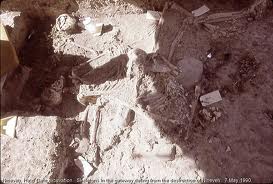
Halzi Gate excavation. Excavating skeletons in the gateway dating from the destruction of Nineveh. 7 May 1990.

2. A cry for righteous judgment, Habakkuk 1:1—6

Here is another prophet we know next to nothing about. His name is mentioned here, and nowhere else in the Bible. There are two things that distinguish Habakkuk from other Old Testament prophets. First is what we read in verse 1:

The prophecy that Habakkuk the prophet received.

Habakkuk is one of the only prophets that is actually referred to as “the prophet.” This suggests that Habakkuk was recognized as a professional prophet.

Second, there is a verse Habakkuk wrote that appears no less than three times in the New Testament and it eventually became Martin Luther’s rallying cry and the watchword for the Reformation:

The just shall live by faith. (Habakkuk 2:4)

Habakkuk was a contemporary of the more famous Jeremiah, and this book is traditionally dated around 600 BC, not long before the Babylonian Captivity in 586 BC. So he ministered in and around Judah and this prophet was faced with with two big problems. This prophet was one of the few men with courage enough to wrestle and argue with God over the way God deals with man.

I will stand at my watch and station myself on the ramparts; I will look to see what he will say to me, and what answer I am to give to this complaint. (2:1)

The answer, of course, is to be found in 2:4b:

The just shall live by faith.

a. The burden of the prophet, vs. 1—4

Here is the cry of a frustrated believer: how long and why. This could well be the the single issue that plagues all believers: Why does God permit evil to continue among His own people—evils like, the iniquity, the injustice, the strife, and the contention? This is an old question, but a new one.

Times were tough for Habakkuk, and they were getting tougher. Things were about to come a head; violence was on the rise, the balance of power was shifting fast in the Middle East and the Babylonians were on the march. However, as the old saying goes, “one man plus God is always a majority.” Habakkuk went straight to the Top with His complaints.

b. A new world power, vs. 5, 6

God’s answer to his prophet is the comfort of assurance: “I am working.” But, here is an instance where God’s answer wasn’t quite what Habakkuk was expecting. God was indeed working, but it wasn’t among His people, it was among the heathen!

Notice, though, the onus is on God’s people to see Him working:

Look at the nations and watch—and be utterly amazed. (vs. 5a)

Sometimes God’s working isn’t all that obvious! Believers have to “look” for Him, and sometimes His hand is to be found working in the strangest of places, among the strangest of people.

God did not answer the “Why” part of Habakkuk’s question; He is sovereign and owes no man any explanation or apology. Besides, no human being is capable of understanding the mind of God. But God did speak to the prophet. Far from being insensitive to the plight of His people, God was in fact orchestrating it! In the darkest, most confusing hour for any believer, when we are apt to feel as though God has forsaken us, we should take comfort from God’s word to Habakkuk. God in no way ever loses control; regardless of what it may look like, God is always in command of the circumstances of our lives. It is our lack of perception that makes God look uncaring or uninvolved. God’s activity, though, is far-reaching. It extends from generation to generation. His work in our lives not only touches us, but reaches out to touch others.

3. Confidence in God’s sovereignty, 3:1,2; 16—19

This last chapter of Habakkuk is unique among the Minors. In fact, it’s not really part of his prophecy. We might call chapter three Habakkuk II, for it opens with a whole new superscription, like it was a whole new book:

A prayer of Habakkuk the prophet. On shigionoth. (vs. 1)

The “shigionoth” is a word of unknown origin and meaning, although is has something to do with music; perhaps an instrument or a type of song.

a. An urgent prayer, vs. 1, 2

What a change had taken place in Habakkuk’s life. From complaining to God and waiting for God to answer him, Habakkuk was brought to the place of real, abiding faith. He was an honest questioner of God and God honored him.

LORD, I have heard of your fame; I stand in awe of your deeds, LORD. Repeat them in our day, in our time make them known; in wrath remember mercy. (vs 2)

What God had revealed to Habakkuk drew the prophet closer to Him and allowed him to worship God anew. He had been given a glimpse into the inner workings of God’s mind. He had a peek of things to come, and what he saw filled him with fear. But the prophet’s fear was not fear of the future but reverential awe of God. God opened His mind to Habakkuk just a crack and the prophet was overcome with wonder.

His heart’s cry to God was based on what God had done in the past: repeat your deeds! What a great, simple prayer for revival! G.B. Williamson gives a wonderful outline of these two verses under the heading, “A Prayer for Revival.”

  • Revival in needed because sin in rampant, religion is decadent, and judgment is imminent, 1:4; 2:18—20;

  • The time of revival is NOW: in “our day, in our time”;

  • The way of revival is through prayer;

  • The hope of revival is in God’s mercy.

b. Remembering God’s power, vs. 16—19

After praising God for His past intervention, Habakkuk says,

I heard and my heart pounded, my lips quivered at the sound; decay crept into my bones, and my legs trembled. (vs 16)

This is why it is so important for believers to get to know God through the pages of Scripture. Prayer is vital, but a believer doesn’t get to know God through prayer. God has revealed Himself to us only through His Word. The closer we get to God, the more we get to know Him through His Word, the more aware of His awesome strength we become. A lot of things may draw us closer to God. Sometimes it’s praise and worship, other times we are literally pushed closer to Christ by adversity. It is during those times that the true believer sees in Him the One who is sufficient to meet every need. Time and again in the Bible we see this. God sustained Elijah when he had reached the end of his rope (1 Kings 19). When Paul faces stiff opposition in Corinth (Acts 18), it was God who was his constant source of help.

Habakkuk’s personal story as revealed in these verses reveals that faith was the prophet’s only ally; all he could was wait.

Yet I will wait patiently for the day of calamity to come on the nation invading us. (vs. 16b)

The threat of the Babylonians was real and Judah’s days were numbers, but all Habakkuk could do was to wait quietly. He waited for the end to come, but he had no fear. We learn something of the dynamics of fear from these verses. We fear things when we attribute to a person, a place, or a thing two important characteristics:

  • Almightiness—the power to take away another’s autonomy;

  • Impendency—the power to do another harm.

What we need to understand is that those things don’t belong to any human being; they belong to God. This Habakkuk understood, which is why he waited patiently for the end to come. His faith sustained him. He knew he rested under God’s protection.

God’s sovereignty is not a topic reserved for theological discussions. It is an important fact in the life of every Christian. We have been redeemed by God. We are His children and we belong to Him. We are of value to God. We are filled with His Holy Spirit, who makes us able servants. By means of God’s power working in our lives, we have the ability to withstand any and all circumstances that come our way.

Habakkuk’s experience is a good example for the modern believer. He may have had questions, perhaps even doubts, he saw things he didn’t like or understand, but he did not give into fatalism. He did not passively resign to what was to come. Even though he may had a bad feeling in the pit of his stomach, Habakkuk had faith, and he had the courage to submit to the will of God and to exercise active dependence on Him.

Habakkuk wanted the people to sing his prophecy:

For the director of music. On my stringed instruments.

And why shouldn’t we sing what Habakkuk wrote? His head wasn’t in clouds, but he knew God and he had the kind of confidence in God that we all need. No matter what the outward circumstances of life may be, the just should simply live by faith. What Habakkuk found to be true, is still true today.

(c)  2011 WitzEnd

HEBREWS, Part 6

Don’t Stop Believin’!

Hebrews 3:7—19

The inspired writer to the Hebrews has spent some time establishing the facts that Jesus Christ, the founder of the Church, is superior to angels, superior to any human priest, and superior to the ever-faithful Moses.

The remainder of Hebrews 3 may seem a little out of place; a couple of Old Testament quotes all strung together for some reason that’s unclear on the surface. However, this seems to be the author’s writing style. He quotes a verse from the Old Testament without any kind of set up or introduction, and then proceeds to explain it by applying its words to his readers.

It seems that in describing the faithfulness of Moses and Jesus Christ, the author thinks of something else. The people to whom he is writing were not exactly paragons of faithfulness, and he is gravely concerned about this shortcoming.

1. The Warning, verses 8—13

Today, if you hear his voice, do not harden your hearts as you did in the rebellion, during the time of testing in the wilderness, where your ancestors tested and tried me, though for forty years they saw what I did. That is why I was angry with that generation; I said, ‘Their hearts are always going astray, and they have not known my ways.’ So I declared on oath in my anger, ‘They shall never enter my rest.’ ”

See to it, brothers and sisters, that none of you has a sinful, unbelieving heart that turns away from the living God. But encourage one another daily, as long as it is called “Today,” so that none of you may be hardened by sin’s deceitfulness.

The exhortation begins with three timely commands, taken from Psalm 95, which is actually the foundation of the third and fourth chapters of Hebrews.

a. Do not harden your hearts, vs. 8—11

The story of the “rebellion” mentioned in Hebrews is found in Numbers 13 and 14, and it has to do with the refusal of the Israelites to obey God in taking the land He had promised to give them. But more about that in a moment.

You’ve probably noticed how often the big little word “if” is used in this letter. “If you hear his voice” is an interesting phrase that says a lot more the longer you think about it. Who in the world can NOT hear God’s voice? It’s difficult to imagine any human being missing an utterance from Almighty God, and yet many people do. When God speaks, human beings are free to listen or ignore. When human beings refuse to listen to God, their hearts harden, and when their hearts harden, God rejects them; they forfeit their opportunity.

Another oft-used word in this letter is “today,” which is used 8 times in it. Its prominent position in the sentence gives it emphasis: immediate action is absolutely imperative. God is speaking today. You must not ignore His voice today.

This first command is given using two examples of rebellion and hardened hearts. The writer wants his readers to remember what happened in the desert during the 40 year wilderness wanderings. He wants them to behave differently then their forefathers did. They ignored God’s voice, but we shouldn’t. People who ignore God’s voice open themselves up for a world of hurt! James in his letter nails it:

You adulterous people, don’t you know that friendship with the world means enmity against God? Anyone who chooses to be a friend of the world becomes an enemy of God. (James 4:4)

So just how serious is it to ignore the voice of God? A short history lesson will show us. Near the beginning of their 40 years in the desert, and after the children of Israel had left the Desert of Sin near Rephidim, they had no water and they were thirsty. When they quarrelled with Moses, God told him to strike a rock, and when Moses did, water flowed from the rock. Moses called that place Massah, which means “testing” and Meribah, which means “quarrelling.” Some 40 years later, near the end of their desert journey, the people of Israel once again ran out of drinking water and quarrelled because of thirst and this time Moses blew his top and instead of speaking to the rock as God told him to do, he lashed out in anger and struck the rock twice in order to make water flow from it as it had decades earlier. Because Moses chose to ignore God’s instructions, he was not allowed to enter the Promised Land.  Those quarrelsome Hebrews were allowed to go in, but Moses, after a lifetime of listening to the voice of God, was not, because this one time he turned a deaf ear to God. It’s a serious thing to ignore God when He’s speaking to you!

b. See to it…that none of you has a sinful, unbelieving heart, vs. 12

See to it, brothers and sisters, that none of you has a sinful, unbelieving heart that turns away from the living God.

John Calvin refers to this “evil heart of unbelief” as a heart riddled with sin, corruption, and wickedness that leads to unbelief. God does not take the sin of unbelief lightly, because He knows that this sin has its origin in the depths of man’s being.

The heart is deceitful above all things and beyond cure. Who can understand it? (Jeremiah 17:9)

Now, obviously, his readers hadn’t reached the point of turning against God, so this stern warning is given. “See to it,” or we might say, “Be alert” or “Watch out!” The necessity of being on guard and alert all the time is, in various forms, a recurrent theme in Hebrews.

The word translated “unbelieving” means “lack of trust and confidence.” It does not refer to an individual, who from time to time, has honest doubts and questions about their faith and seeks answers in the right place, God’s Word, and from the right Person, God. The kind of “unbelief” referred to in Hebrews infects every aspect of an individual’s life and opens them up to all other sins. An unbelieving heart is like a “gateway sin,” that leads to one deeper and deeper into a life of sin, wickedness, and corruption.

How a person avoids an unbelieving heart is the subject of the last command:

c. Encourage one another daily, vs. 13

But encourage one another daily, as long as it is called “Today,” so that none of you may be hardened by sin’s deceitfulness.

The best defense is offense, and the best way of preserving one’s own soul is to be watchful of the spiritual welfare of others. A strong sense of “group responsibility” is the sign of a healthy church!

The word “daily” gives us an idea of how often we should encourage one another in the faith: DAILY. In other words, it should be our habit to watch out for each other; to make sure our fellows are faithful and growing in the faith. This is not being nosy; it’s being obedient to the Word of God. Christians are like burning embers; together they feed each other’s fire, generating heat as long as they remain united. When Christians are separated from each other, they soon cool off and die. Christians should be committed to building each other up all the time, not just on Sunday morning in church. Believers should see to it that whenever we are together, whether we are at work or at play, something is included which will reinforce our faith and our spiritual zeal and holy purpose.

So we are to be continually at this, but there is a limitation. We may encourage each other “as long as it is called Today.” There is a limitation—a period of time—in which the faith response may operate. There is a window of opportunity for an errant believer to change his ways. If he doesn’t do it “today,” it will be too late. Timely obedience is one of the great dynamics of Christian life.

2. Eternal, conditional security, verses 14—19

We have come to share in Christ, if indeed we hold firmly till the end our original conviction. (verse 14)

Once again we read that gigantic word “if,” and it has a greater emphasis that the rest of the words of verse 14. “If” usually comes from the Greek ean, but this time the word translated “if” is eanper, which is a “strong if.” The TNIV helps us see the strength of this occurrence of “if” by translating eanper “if indeed.” It’s an “absolute if.”

The word “share” is a remarkable one. The word is ginomai, “to become,” in the perfect tense, which means our present state is based on a past but sustained action. In other words, our present state of salvation, which is based on our past conversion, or “conviction” in the text, is sustained today only if we our faith is maintained until the very end of our lives.

This idea of never giving up the faith is so elemental, even Journey realized it!

Don’t stop believin’
Hold on to the feelin’
Streetlights, people
Don’t stop believin’
Hold on
Streetlights, people

Christians must never let go of the faith, no matter how many doubts my filter through your mind. You may wonder about aspects of your faith. You may question aspects of your faith. But you must always hold on to your faith if you want to continuing sharing in Christ.

Again in verse 15 the writer reminds his readers that “today” is the day God is speaking to His people. Today is an opportunity to hear His voice and respond to it. God will not stop speaking to a believer unless that believer lets go of His faith and confidence in Christ.

The writer’s point in this chapter is declaring that believers can have fellowship with Christ only as long as they endure and never give up their faith. Our prayers will be answered only if we keep the faith. God will deliver us from hard hearts and forgive us of rebellion and disobedience and will ultimately deliver us from death on as we keep on believing.

The unbelieving, faithless Hebrews had a big problem:

So we see that they were not able to enter, because of their unbelief. (verse 19)

Because they lost faith; because they stopped believing, these people were unable to enter the Promised Land. Likewise it is we Christians who maintain our faith and hang tough until the end who are assured of entering our Promised Land. Unbelieving people will never enter into God’s heavenly rest.

(c)  2011 WitzEnd

A SURVEY OF THE MINOR PROPHETS, Part 6

Jonah and God’s Compassion

Jonah

What we know about the prophet Jonah we find in 2 Kings 14:25—

He was the one who restored the boundaries of Israel from Lebo Hamath to the Dead Sea, in accordance to the word of the Lord, the God of Israel, spoken through his servant Jonah, son of Amittai, the prophet from Gath Hepher.

The “he” of this verse is Jeroboam, king of Israel, who reigned from 781—753 BC, so we know the date of Jonah’s ministry. During the Jeroboam years, Israel experienced a time of political and economic revival as the fortunes of Assyra waned.

Even though our glimpse of Jonah’s life is only 48 verses long, they are a powerful 48 verses, full of great spiritual truth. Scholars have found these to be the major themes in the book:

  • The sovereignty of God. God accomplished His plans in spite of Jonah’s failures.

  • Mercy and grace. God is compassionate to whomever He wants to be, whether a sinful nation or a struggling prophet.

  • Responsibility. If we claim to know God, we have a responsibility to serve Him to the best of our ability.

  • Servanthood. Jonah’s disobedience is a classic example of how NOT to serve God.

  • Repentance. God always gives people time to repent.

  • Missions. God reaches out to people everywhere.

1. God’s patience with disobedient believers

You don’t see a lot of missionary activity in the Old Testament. In fact, it’s pretty safe to say that “evangelism” is a New Testament concept and activity. The book of Jonah, though, teaches us that even way back in the days of the Old Testament, God was concerned with sinners, those outside of the Covenant.

Jonah is the reluctant missionary. God called him to a task that he wanted to avoid. He was, after all, a prophet. His job was to proclaim God’s Word to his people. Why in the world did God now want this prophet to take God’s Word to other people?

a. The fleeing prophet, 1:1—3, 17

Go to the great city Nineveh and preach against it, because its wickedness has come up before me.”

This is God’s commission and call of Jonah. Nineveh is referred to here as “the great city” because at this time it was a world power. Even though the Assyrian Empire was struggling, Nineveh was the seat of power in the ancient world. It may have been a great city, but it was also a wicked city. The fact that God was concerned about this city shows us that God’s concern and even love reached beyond His chosen ones, even though they believed they were only ones He truly loved.

But Jonah, full of fear and apprehension, decided that this mission was not for him. So he boarded a ship that was sailing in the opposite direction. But of what was Jonah fearful? We might think he was afraid of the Assyrians; afraid that they would harm him. But, in fact, he was afraid they would turn and repent and that God would indeed forgive them. It’s not that Jonah wanted people to die in judgment, it was that if Nineveh was spared, then he would appear to be a false prophet in the eyes of his people back home.

Now the Lord provided a huge fish to swallow Jonah, and Jonah was in the belly of the fish three days and three nights. (verse 17)

Jonah was clearly in disobedience to God, and in act of discipline mingled with mercy, God provided a big fish that swallowed up the errant prophet. We aren’t told how big this fish was. Matthew 12:40 speaks of “a whale,” but the Greek word used there means “a huge fish” or even a “sea monster.” For three days and three nights Jonah remained in the belly of the fish. This expression is probably a colloquial expression suggesting a relatively short, indefinite period of time.

This incident brings back to our minds the beautiful words of the Psalmist—

Where can I go from Your Spirit? Or where can I flee from Your presence?…If I take the wings of the morning, and dwell in the uttermost parts of the sea, even there Your hand shall lead me, and Your right hand shall hold me. (Psalm 139:7, 9—10, NKJV)

b. The returning prophet, 2:1—10

Jonah knew he was in the wrong and cried out to God for help from within the fish. Jonah was wrong to rebel and run away from God, as if hiding among a bunch of Phoenician sailors would work! Jonah was also wrong about by taking refuge among these godless sailors, because he was implicitly declaring that, for this moment in time at least, he was preferring the Canaanite way of life to that of Israel.

Rather than dying inside the big fish, Jonah called to God for help, and we have recorded for us in poetic form, the prayer he prayed. It chronicles how dumb he was to do what he did. Yet even in his stupidity, Jonah had the presence of mind to remember God and His compassion. The prophet recommits his life to the Lord:

But I, with shouts of grateful praise, will sacrifice to you. What I have vowed I will make good. I will say, “Salvation comes from the Lord.” (verse 9)

On the heels of Jonah’s confession and his recognition that God alone is his deliverer, the big fish pukes up the prophet, right onto dry land. We are not told just where he was deposited, but he was free, once again, to do God’s work. This man of God learned the hard way that fleeing from God’s will in an effort to avoid difficult tasks always results in even greater difficulties.

2. God’s compassion for unbelievers, 3:1—10

God is a God of second chances, even in the Old Testament. Abraham, Moses, Saul, and David are among the people in the Old Testament who personally experienced a “second chance” to make it right with God. In chapter 3, Jonah’s story reboots with his “second chance” to fulfil his mission to evangelize the great city, Nineveh and save it from certain destruction.

a. The prophet obeys, vs. 1—4

Then the word of the Lord came to Jonah a second time: “Go to the great city of Nineveh and proclaim to it the message I will give you.” Jonah obeyed the word of the Lord… (verses 1—3a)

At this point in the story, it seems as though our intrepid prophet has learned his lesson. There is a New Testament parallel in the experience of Peter. His first commission is found in Mark 1:16, 17 and Luke 5:10. After his failure and restoration, Peter was recommissioned as we read in John 21:15—17. How wonderful it is to serve a God that knows us and gives us the opportunity to hear and to respond to His call more than once!

Jonah had been forgiven by God, but he had to take up his cross where he laid it down. He had to go to Nineveh and preach the Word God would give to Him. To keep God’s restored favor and blessing, he, like all of us, had to face up to the same issue we sought to escape. God is compassionate, but He is also firm. Remember what what Samuel cautioned Saul:

To obey is better than sacrifice, to harken than the fat of rams. (1 Samuel 15:22, KJV)

Or, as Father Mapple said in his classic sermon:

And if we obey God, we must disobey ourselves, and it this disobeying ourselves wherein the hardness of obeying God consists. (Herman Melville’s Moby Dick)

b. A surprising response, vs. 5—10

What an amazing site greeted the prophet as he approached Nineveh. The inner city was surrounded by a wall 100 feet thick, wide enough for 3 chariots to drive side-by-side on. The walls had 1,500 towers, 100 feet in height. Huge lions and bulls carved our of stone guarded its 27 gates. Stunning gardens surrounded the public building, which were ornamented with alabaster and beautiful sculptures. Acres and acres of lush gardens were to be found within the city walls so fresh produce was always available. But, at the same time, Assyria’s national economy was in dire straights. The whole Empire, and Nineveh in particular, was in the grips of a devastating depression. And this could explain their readiness to hear, listen to, and respond to the Word of God as they did.

When God saw what they did and how they turned from their evil ways, he relented and did not bring on them the destruction he had threatened. (verse 10)

God spared the city just as He had spared the sailors. God’s incredible response to sinners in this short book foreshadows Paul’s teaching in 1 Timothy 2:4—

(God) wants all people to be saved and to come a knowledge of the truth.

3. God illustrates His compassion, 4:1—11

a. The prophet’s prejudice, vs 1—3

Now, Lord, take away my life, for it is better for me to die than to live. (verse 3)

Maybe it was his national pride and his self-esteem that caused Jonah to resent the fact that God responded in compassion and forgiveness to the Ninevehites. He may have felt that if Assyria, the promised destroyer of Israel were destroyed, then Israel itself would be spared. This, of course, would have been faulty reasoning, since it wasn’t really Assyria that destroyed Israel, it was Israel’s own sins.

The petulant prophet blamed God for everything from sparing a godless city to his own disobedience. Amazingly, he defended his own failure by blaming God’s loving-kindness!

Jonah felt humiliated and discredited. Overcome with self-pity, he felt it would be better for him to die rather than face embarrassment back home.

Another prophet, Elijah, also got depressed over the outcome of events of which he was a part. He too wanted to die.

He came to a broom bush, sat down under it and prayed that he might die. “I have had enough, Lord,” he said. “Take my life; I am no better than my ancestors.” (1 Kings 19:4)

The difference between Elijah and Jonah was that Jonah was depressed because so many sought God, Elijah was hurt on God’s behalf because so few sought God. We could say that Elijah was jealous for god, but Jonah was jealous of God.

b. God’s compassion on Jonah, vs. 4—6

All at once an angel touched him and said, “Get up and eat.”

God had rescued Jonah from death when he was in blatant rebellion against Him. But now, the Lord reasoned with him. God wanted to know why His prophet was so angry. God was displeased with Jonah’s attitude, yet He did not openly rebuke Him. Like a parent who practices good parenting skills, the Lord worked with Jonah so that he would see for himself how childishly he was behaving, and then hopefully he would change his attitude.

c. A stern lesson, vs. 7—11

This group of verses is interesting:

  • God provided a gourd.

  • God provided worm that ate the gourd.

  • God provided a scorching wind.

What lesson was God trying to get Jonah to learn?

Jonah was thrilled with the plant, but was angry when it went away. Jonah could see no further than his own discomfort. Then God drove the point home. Jonah had been upset over something insignificant—a plant which he neither planted nor tended. Why didn’t he have the same concern over the eternal destiny of the population? Yes, Jonah’s priorities were completely out of whack.

The book of Jonah ends with God asking his prophet a final question, to which there was no answer recorded:

...should I not have concern for the great city, Nineveh, in which there are more than 120,000 people who cannot tell their right hand from their left—and also many animals? (verse 11)

God was trying to show Jonah that he was blind; his religious exclusiveness blinded him to the needs of ignorant sinners. Almost all believers, from time to time, behave like Jonah. We overvalue the less important things of life, like the gourd. We also, from time to time, even when thinking about spiritual things, do so in their relation to ourselves, or our own “little world.” However, God’s concern reaches out the last person on earth.

The Lord is not slow in keeping his promise, as some understand slowness.

(c) 2011 WitzEnd

HEBREWS, Part 5

Jesus vs Moses, 3:1—6

For two chapters, the author of Hebrews has developed his argument, using passages from the Old Testament, that Jesus is superior to angels. Jesus is the author of a great salvation and great enough to become a man in order to accomplish it. But the people to whom this letter is addressed are Jews. and who was a very important Jew? Moses, of course. So, as if to head off the notion that among the Jews Moses might have been greater than Jesus, Paul turns his attention to that thorny issue.

The voice of Moses had become synonymous with the voice of God to the Jews. Appealing to Moses stopped any dispute. It may be difficult for us today to understand, but for these Jews, the transfer of faith and allegiance from Moses to Jesus was not an easy thing, and there was the nagging temptation to return to Moses.

So, having demonstrated the greatness of Jesus to angels and the priesthood, it was time to deal with Moses.

1. Don’t get distracted, 3:1

Therefore, holy brothers and sisters, who share in the heavenly calling, fix your thoughts on Jesus, whom we acknowledge as our apostle and high priest.

The “therefore” is important because it links chapter 3 with what the teacher had just written about the unity Jesus has with His brothers and sisters. Together, we are part of the great family of God. The brothers and sisters to whom this letter was written were made holy by Jesus. The word “holy” is also important. It’s an adjective that indicates these people had been sanctified; the guilt of sin had been removed from them through the suffering and death of Jesus. These folks had been separated from the rest of humanity, as all Christians have been, by an act of Jesus on their part. They belonged to Him.

Not only were these people holy, but, along with the author, they “share in the heavenly calling.” What is “the heavenly calling?” The phrase indicates a number of things. First, it shows that salvation—the creation of holy brothers and sisters—is God’s initiative, not man’s. The decision to save and sanctify comes from heaven. God has called man to become His own and because Jesus has taken on our natures, He is more than able to help us answer that call.

But it means even more than that. The “heavenly calling” is not only a spiritual calling to enter the Kingdom of Heaven, but a practical one, as well. Notice what Hebrews 9:14 says:

How much more, then, will the blood of Christ, who through the eternal Spirit offered himself unblemished to God, cleanse our consciences from acts that lead to death, so that we may serve the living God!

So the “heavenly calling” also has something to do with serving the Lord in the present world; it has to do with “good works.” Not only have we been saved by grace through faith, which is a work of God and not our personal work, but we have been created for good works that God has in mind for us to do. How many Christians know Ephesians 2:8 and 9 by heart but are totally ignorant of verse 10:

For it is by grace you have been saved, through faith—and this is not from yourselves, it is the gift of God—not by works, so that no one can boast. For we are God’s handiwork, created in Christ Jesus to do good works, which God prepared in advance for us to do.

These ideas are followed by the advice to “fix your thoughts on Jesus.” Another way to translate that admonition is to “consider Jesus.” The Greek word means “to bring your mind down on this one” thought; “think carefully about” something. That’s a good advice. It’s far too easy to get distracted by other things and people that take our attention away from Jesus. So, it’s vitally important to stay focused on Him.

But, why is Jesus called “an apostle?” We can understand why He is called a High Priest, but an apostle? This is the only time Jesus is referred to an apostle, and it seems odd. The basic idea the writer is trying to convey to his audience is that God “sent” Jesus; He sent Jesus to accomplish a definite purpose. Like human apostles, Jesus was given the authority to speak for the One who sent Him: God the Father.

But the word means even more than that. If we remove the prefix, apo, we are left with the word stolon. You may not know that word, but biologists do, and they use this word to describe a type of root that descends from a plant having the capability of putting down a new set of roots. You might call that plant “crabgrass.” And if you’ve every tried to get that crabgrass out of your lawn, you see how pervasive that root system can be! Those darn stolons are always establishing new colonies of crabgrass all over your lawn!

So Jesus is like crabgrass in the sense that He was sent by the Father with the authority to establish a new “colony of heaven” here on Earth. Christ in turn has given us that same authority to establish new, smaller “colonies of heaven,” which we call “churches.”

Hence, Jesus is an apostle, as we are. He is faithful to God the Father as we should be.

2. Jesus and Moses were both faithful, 3:2

He was faithful to the one who appointed him, just as Moses was faithful in all God’s house.

The emphasis in this verse is not that Jesus “was faithful,” but that He was faithful to “the one who appointed him.” Part of being both an apostle and a high priest is being absolutely faithful to God. Now, Moses was also faithful in the house of God. Moses was faithful to speak the words God wanted him to speak. He accomplished the things God commanded of him. Moses is the perfect example of a human being who lived a life of obedience to God. No, he was not perfect. Moses made mistakes. But the writer gives Moses his due, comparing our Lord’s perfect faithfulness to his.

Moses ministered faithfully in God’s house—the “church of God in the wilderness”—during the 40 year wilderness wandering of the Hebrews. But, there is a vital difference between Jesus and Moses.

3. Jesus is different, 3:3, 4

Jesus has been found worthy of greater honor than Moses, just as the builder of a house has greater honor than the house itself.

Jesus is vastly different from Moses because while Moses served in God’s house, Jesus built the house! Jesus is not a mere servant; He actually created the house. So the Son is worthy of more honor than Moses. Now, Moses was certainly an honorable person, but he pales in comparison to Jesus; his honor just can’t measure up to Jesus’.

We may admire a magnificent building, but it’s the architect who gets the award. In that sense, Jesus is greater than Moses. Moses was always just a member of the people of God. He had great honor within that body, but Moses could never be more than that. But not so Jesus; He was more. Yes, Jesus became like those He came to save, but He was always more than those He came to save! And as the Son of God and man, He built the house of God—the Church.

Verse 4 is kind of parenthetical thought. Jesus created the house of God—He founded the Church—but it’s God who is creator of all.

For every house is built by someone, but God is the builder of everything.

So, we can see the teacher’s strategy here. There is a relationship between Creator and creature. Christ is the builder but Moses was part of the house being built. Christ is over the house, Moses is in the house. Christ is the Son, Moses a servant.

4. The new is better than the old, 3:5, 6

Moses was faithful as a servant in all God’s house,” bearing witness to what would be spoken by God in the future. (verse 5)

The main point in verse 5 is the last phrase. In a sense, Moses functioned as a prophet and was a foreshadow of Jesus, the great Prophet. All that was revealed to Israel through Moses anticipated things yet to come. This is a powerful thought that would hit these Hebrew readers right between the eyes. Jesus is superior to Moses, and the words of Jesus are superior to the words of Moses because those words—the Law—simply foreshadowed what God would speak later on. This simple statement shows how temporary and anticipatory the Law really was. This must have been a big pill for some of the readers of this letter to swallow and digest!

And we are his house, if indeed we hold firmly to our confidence and the hope in which we glory. (verse 6b)

This verse tells us that the Hebrew readers of this letter were saved and that obedience to revelation is evidence of the genuineness of anyone’s salvation.  The children of Israel by faith accepted the plan of redemption they were given by God through Moses. In obedience, they sacrificed the lamb, put its blood around the door posts of their homes. There was no rebellion at that point. However, after they experienced their redemption—deliverance from Egypt—God’s newly redeemed people continually rebelled against Moses. Sadly, that entire redeemed generation was characterized by complaining and murmuring, grumbling and discontent with everything. No wonder the writer to the Hebrews cautioned his readers to “hold firmly.”

The “people of God as a house” metaphor is seen frequently in the New Testament. The author tells his readers that we, believers, are the house of God. This means that those who confess Christ as Savior, not those who practice Judaism, constitute the household of God. Christians acknowledge Christ as the chief cornerstone. But, the teacher places two limitations on being a part of God’s house.

a. If we hold firmly to our confidence. We can no longer be a part of God’s house if we lose our confidence or our courage. For these Hebrews, backsliding into Judaism was a constant danger, so our writer urges them to hold onto their confidence in the Word of God concerning Jesus Christ in the face of the fierce opposition they must have been facing from their families and friends. Gentile Christians, too, must be faithful in the face of any kind of persecution. The word translated “confidence” in the TNIV is translated “courage” in other versions of Scripture. The Greek word is particularly significant for the Christian because it relates to our boldness and frankness in sharing the Gospel

b. The hope in which we glory. If the readers of this letter no longer hold on to the hope they’ve boasted about in the past, then they are no longer part of the household of God. This “hope” is something the author deals with later on:

God did this so that, by two unchangeable things in which it is impossible for God to lie, we who have fled to take hold of the hope set before us may be greatly encouraged. We have this hope as an anchor for the soul, firm and secure. It enters the inner sanctuary behind the curtain… (6:18, 19)

The “hope” every Christian has is in God’s unchangeable purpose and the fact that God cannot lie; that He is absolutely trustworthy.

Just as God is true to His purpose and character, so we must be a true reflection of Him as our Creator and Redeemer. If we fail, then we cease to be a part of God’s house. This is why throughout Hebrews the writer urges his readers to be faithful to their calling.

Let us hold unswervingly to the hope we profess, for he who promised is faithful. (Hebrews 10:23)

That’s not easy to do. We want easy things to believe it. But knowing Christ involves a lot more than merely mouthing the right words. It involves a solemn responsibility to live in obedient submission to Him. Because if we don’t, we are in danger of forfeiting His blessings in our lives, and perhaps even life itself.

(c)  2011 WitzEnd

Bookmark and Share

Another great day!

Blog Stats

  • 406,905 hits

Never miss a new post again.

Archives

Email Subscription

Enter your email address to subscribe to this blog and receive notifications of new posts by email.

Join 282 other subscribers
Follow revdocporter on Twitter

Who’d have guessed?

My Conservative Identity:

You are an Anti-government Gunslinger, also known as a libertarian conservative. You believe in smaller government, states’ rights, gun rights, and that, as Reagan once said, “The nine most terrifying words in the English language are, ‘I’m from the government and I’m here to help.’”

Take the quiz at www.FightLiberals.com

Photobucket